
The Mistake Most Homeowners Make First
The garage door won't open, the remote isn't working, and the car is trapped inside. The instinct is almost universal: reach up, grab the red cord hanging from the opener trolley, and yank it. It feels like the obvious fix because that cord is the one visible, hands-on control most people ever touch on their garage door. It's tempting because it looks simple — pull cord, door moves freely, problem solved. The trouble is that the cord doesn't fix anything. It only disconnects the door from the opener, and what happens next depends entirely on what's wrong with the door in the first place.
What the Cord Actually Does
The emergency release is a mechanical disconnect between the opener's trolley and the carriage that rides along the rail. Pulling it takes the motor completely out of the equation, leaving the door's springs, cables, rollers, and tracks to do all the work of holding it up or letting it down. That's it. It doesn't release tension, doesn't fix a broken part, and doesn't make a heavy door light. It just hands control back to you and to gravity.
What Goes Wrong, and How Badly
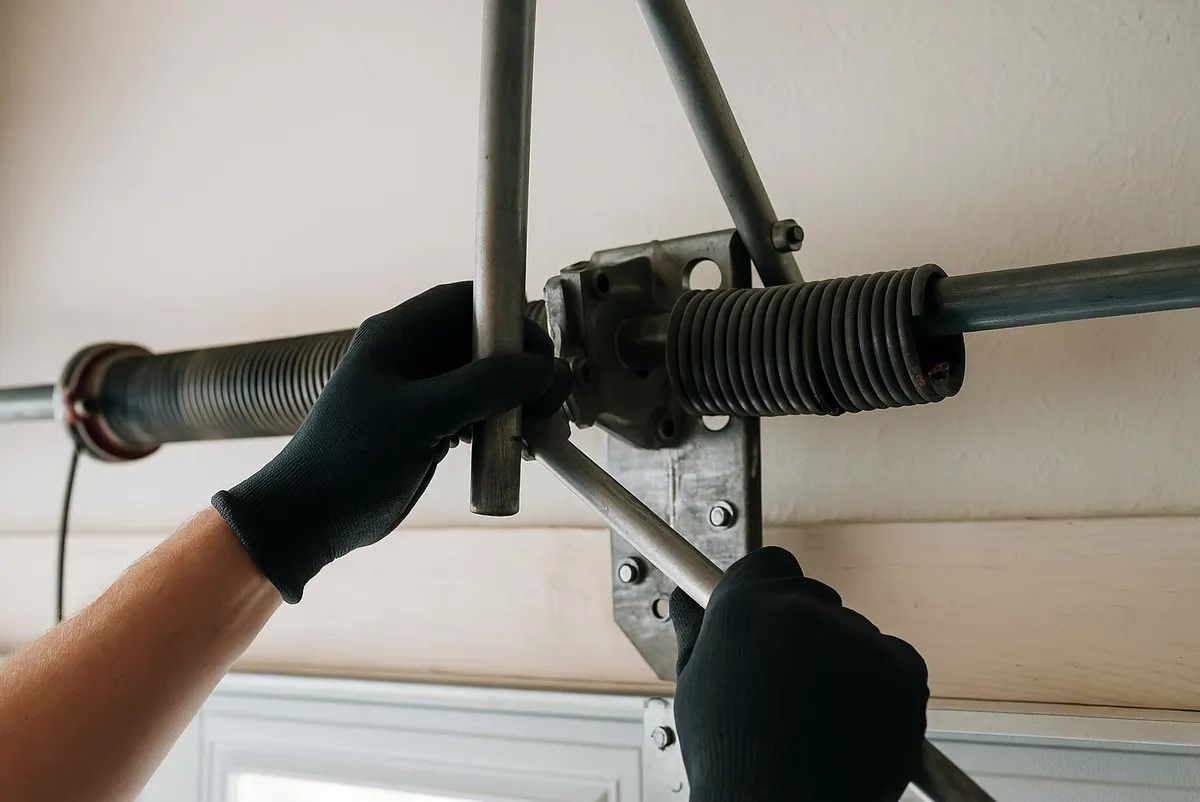
A standard residential garage door weighs somewhere between 130 and 400 pounds, and in a working system, the springs counterbalance almost all of that weight so the door feels light to lift. Pull the release cord on a door with a broken spring, or one where a spring is already weakened, and that counterbalance is gone. The door can drop fast and hard — hard enough to injure a hand, a foot, or anything underneath it, and hard enough to pop a cable off its drum or jump the door out of its track.
The other common failure happens in reverse: someone pulls the cord while the door is sitting in the up position, assuming it's safe because it's already open. If a spring has quietly failed or a cable has frayed, nothing is holding that door up once it's disconnected from the opener, and it can come down on its own.
When Pulling the Cord Is the Right Move
The release cord earns its keep during power outages, which aren't rare here given how often summer storms roll through with wind and hail. If the opener has lost power but the door itself is undamaged — springs intact, tracks straight, rollers turning freely — disengaging the trolley lets you lift and lower the door by hand so you can get a vehicle in or out. It's also the right call when the opener motor or circuit board has failed but the mechanical parts of the door are fine; manual operation is a legitimate stopgap until the opener is repaired.
When It Makes Things Worse
Don't pull the cord if the door is already struggling — grinding, hanging crooked, moving in jerks, or refusing to budge under power. Those are signs of a broken spring, a bent track, or a snapped cable, and disengaging the opener in that moment removes the one thing (the motor) that might have been holding the door in a controlled position. This matters more here than in milder climates: sudden severe storms and heat-stress cycling on springs mean a spring can let go without warning, often right when you most need the door to work.
Specific Actions That Prevent Trouble
- Test the balance monthly. Disconnect the opener with the door closed, lift it halfway by hand, and let go. A balanced door stays put; one that drops or shoots up has a spring problem that needs attention before you rely on manual operation.
- Only disengage with the door closed unless you've just confirmed the springs and cables are in good shape.
- Use both hands and lift from the center of the bottom panel, not the edges, to avoid the door twisting off its track.
- Reconnect the trolley properly once power or the opener is restored — running the opener while the carriage is still disengaged can damage the motor or drive mechanism.
- Never use the release cord as a workaround for a door that won't open under power. That's a repair issue, not a manual-override issue.
When to Call Yukon Garage Door Specialists
If the balance test fails, if the door drops unevenly, or if you've had to use the manual release because of storm damage or a dead opener, it's time for a trained eye. Our technicians handle spring replacement with the correct torque and tension settings, and we service and repair garage door openers so you're not left guessing whether the motor or the mechanics are the problem. We also run emergency garage door service for the moments storms knock out power or damage a door outside normal hours.
If your garage door in Yukon, Mustang, El Reno, or anywhere nearby isn't lifting, balancing, or responding the way it should, call Yukon Garage Door Specialists today and we'll get it sorted safely.